 Skip to content
Successful concrete block production depends on more than purchasing a machine and starting production. Manufacturers must control several factors to produce strong, accurate, and durable concrete blocks. Among these factors, three elements have the greatest impact on manufacturing success: Machinery, Material, and Manpower.
These three elements are commonly known as the 3Ms of manufacturing.
Mr. Jigar Patel of Revomac Industries explains that machinery, material, and manpower must work together throughout the production process. A weakness in any one of these areas can reduce product quality, increase production costs, create delays, and affect business growth.
A manufacturer may have an advanced concrete block machine, but poor-quality raw materials can still produce weak blocks. Similarly, quality materials and modern machinery cannot deliver the expected results without trained operators.
Understanding and balancing the 3Ms is therefore essential for every concrete block, paver block, and brick manufacturer.
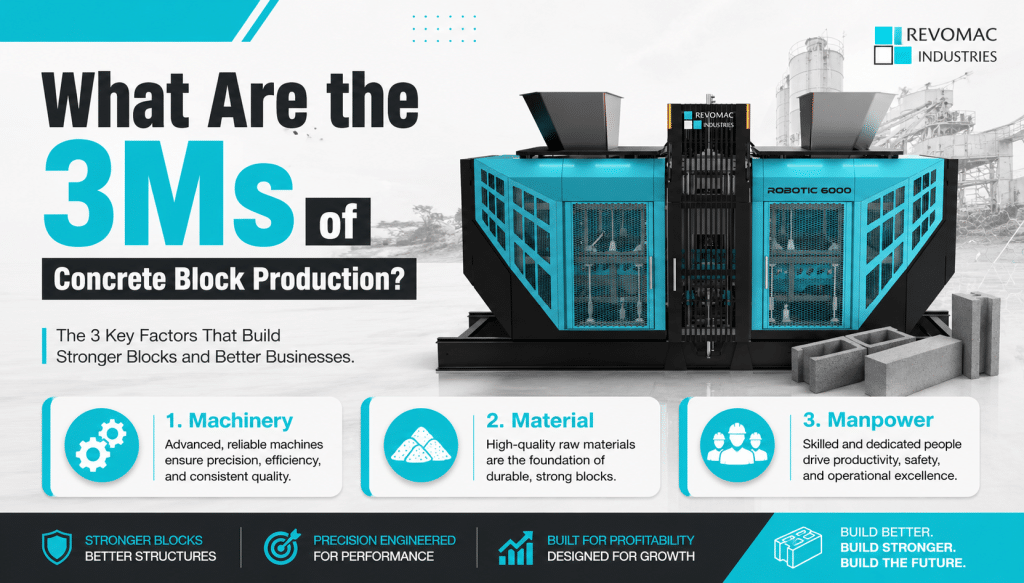
The three most important factors in concrete block manufacturing are:
Each factor performs a different function. However, all three are connected.
Machinery controls the production process. Materials determine the physical quality of the blocks. Manpower manages the machine, material mixture, quality checks, and overall workflow.
When these three elements are properly managed, manufacturers can achieve:
Let us understand the importance of each factor in detail.
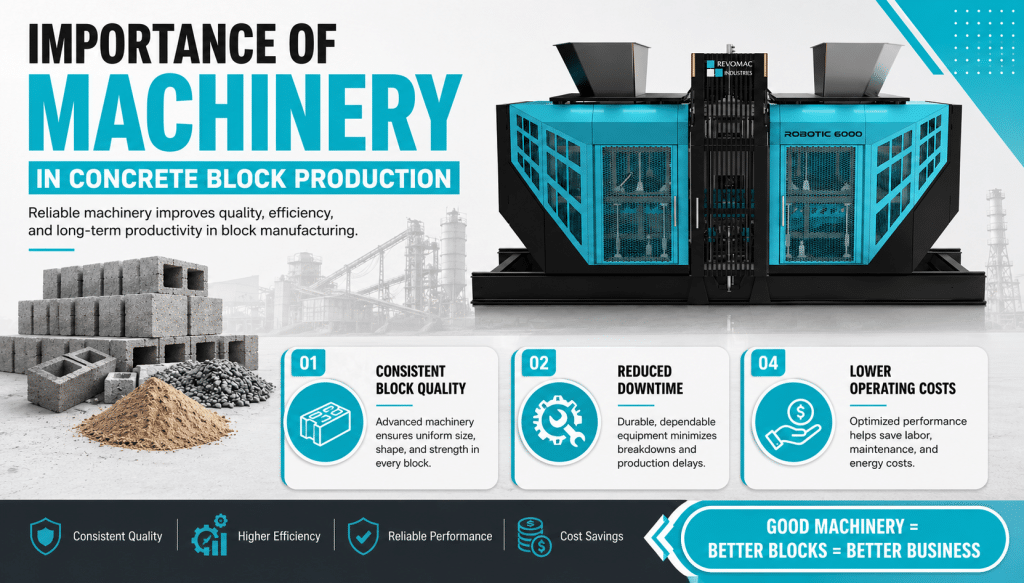
Machinery is the foundation of a modern concrete block manufacturing unit. The type and quality of the machine directly affect production speed, block accuracy, consistency, and labour requirements.
A reliable concrete block machine helps manufacturers produce a large number of blocks in less time. It also maintains uniform pressure, vibration, filling, and moulding during every production cycle.
Consistent Block Quality
Consistency is one of the biggest advantages of using the right machinery.
Every concrete block should have the correct size, shape, density, and surface finish. Variations in block dimensions can create problems during construction. Poorly shaped blocks may increase mortar usage and slow down installation.
A well-designed machine maintains stable vibration and hydraulic pressure. This helps ensure that every block meets the required quality standards.
Faster Production
Manual production methods require more time and labour. They may also produce inconsistent results.
Automatic and semi-automatic concrete block machines improve production speed. They can complete several production cycles within a short period. This allows manufacturers to fulfil larger orders and reduce delivery delays.
Higher production capacity also helps businesses serve builders, contractors, infrastructure companies, and government projects.
Reduced Downtime
Machine downtime affects both productivity and profitability. Frequent breakdowns can delay orders and increase repair expenses.
Manufacturers should select machinery made with reliable components and strong construction. Regular maintenance must also be carried out according to the manufacturer’s recommendations.
Operators should inspect hydraulic systems, vibration units, electrical panels, moulds, conveyors, and moving parts. Preventive maintenance can identify small problems before they cause major breakdowns.
Lower Operating Costs
The right machine can reduce long-term operating costs.
Modern machinery uses controlled pressure and vibration to produce compact blocks. It also reduces unnecessary material loss and dependence on manual labour.
Energy-efficient machines can further reduce electricity consumption. However, manufacturers should not select a machine only because of its low purchase price.
They should consider production capacity, maintenance requirements, spare-part availability, energy usage, automation level, and expected service life.
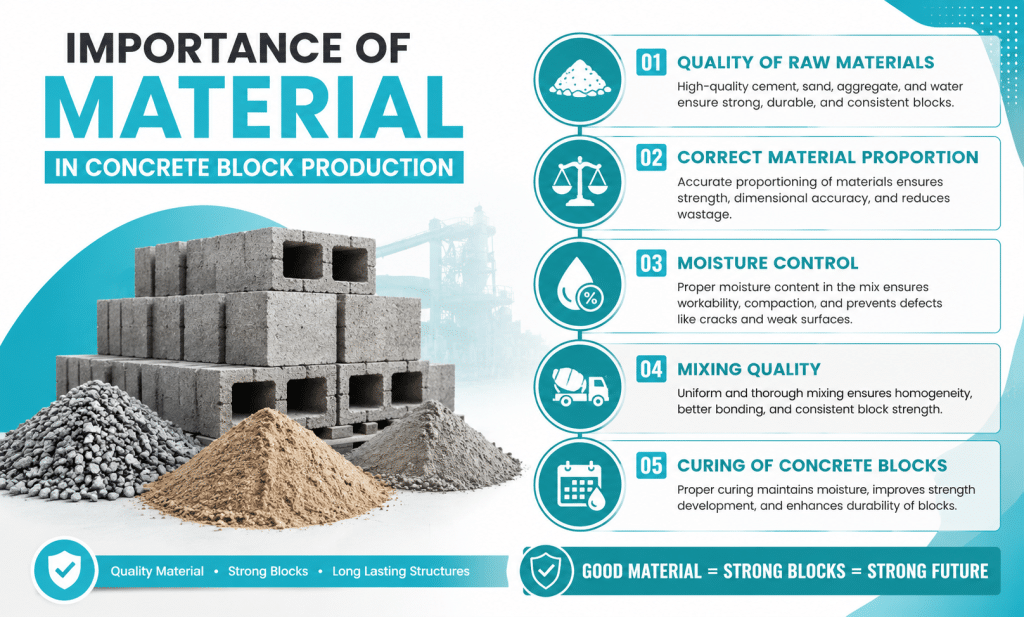
Raw materials determine the strength, durability, weight, colour, and finish of concrete blocks. Common materials used in concrete block production include cement, sand, stone dust, fly ash, aggregates, water, and other approved additives. The exact mixture depends on the type of product being manufactured. Products may include solid blocks, hollow blocks, paver blocks, kerbstones, interlocking blocks, and fly ash bricks.
Quality of Raw Materials
High-quality materials are necessary for producing reliable products.
Poor-quality cement may reduce bonding strength. Sand containing excess clay, dust, or organic impurities can affect the final mixture. Incorrectly sized aggregates can create gaps inside the blocks.
Contaminated water may also interfere with the chemical reaction between cement and other ingredients.
Manufacturers should therefore inspect all incoming materials. Raw materials must be stored properly to protect them from rain, moisture, soil, and other contamination.
Correct Material Proportion
Using quality materials is not enough. The materials must also be mixed in the correct proportion.
Too much cement can increase production costs without providing equal benefits. Too little cement may produce weak and fragile blocks. Excess water can reduce density and create surface defects.
A dry mixture may not fill the mould correctly. This can create broken edges, incomplete corners, and uneven surfaces.
Manufacturers should develop a standard mix design for each product. The approved formula should be followed during every production batch.
Accurate weighing and batching systems can improve mixture consistency and reduce human error.
Moisture Control
Moisture content plays an important role in concrete block production.
The material should contain enough moisture to support proper compaction. However, the mixture should not become too wet.
The required moisture level may change depending on the type of sand, aggregate condition, climate, and production method.
Operators should regularly check the mixture before feeding it into the machine. Proper moisture control improves mould filling, block density, edge quality, and demoulding performance.
Mixing Quality
All materials must be mixed evenly.
Uneven mixing can cause some blocks to contain more cement while others contain more sand or aggregate. This creates variations in strength and appearance.
A reliable mixer should distribute cement, water, sand, and aggregates throughout the batch. The mixing time should be controlled instead of being decided randomly.
Consistent mixing improves production stability and reduces rejected products.
Curing of Concrete Blocks
Material management does not end after the blocks are moulded. Proper curing is necessary for strength development.
Fresh blocks must be protected from rapid moisture loss. Incorrect curing can cause cracks, weak edges, low strength, and poor durability.
The curing method and duration depend on the product, cement type, weather conditions, and production system.
Blocks should not be dispatched before they achieve the required strength. Rushing the curing process may create customer complaints and damage the manufacturer’s reputation.
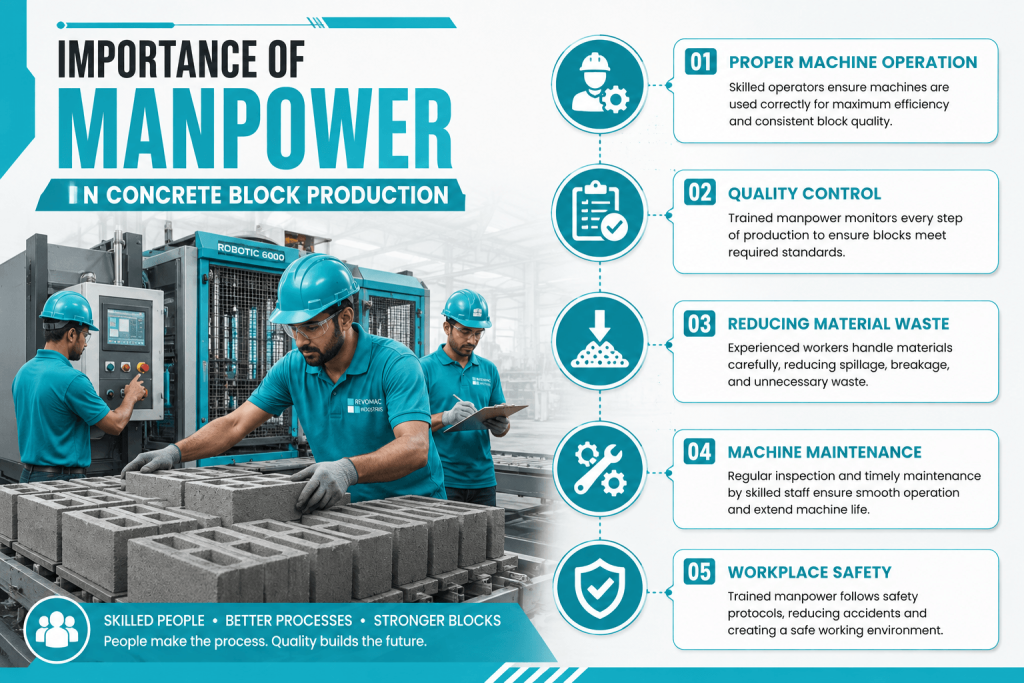
Even the most advanced machine requires skilled manpower.
Operators, supervisors, maintenance technicians, quality-control staff, and material-handling workers all contribute to successful production.
Their knowledge and discipline affect machine performance, product quality, workplace safety, and daily output.
Proper Machine Operation
Trained operators understand how to start, operate, adjust, and stop the machine correctly.
They monitor vibration, hydraulic pressure, material feeding, mould filling, and cycle timing. They can identify unusual sounds, movements, or changes in machine performance.
An untrained operator may use incorrect settings or ignore warning signs. This can cause poor-quality blocks, machine damage, and production delays.
Manufacturers should provide proper training before allowing any employee to operate the equipment independently.
Quality Control
Manpower is also responsible for inspecting finished products.
Workers should check block dimensions, edge quality, surface finish, colour consistency, density, and visible cracks. Regular strength testing should be carried out according to applicable standards.
Quality problems should be identified immediately. Continuing production without correcting the issue can result in a large quantity of rejected blocks.
A clear quality-control process helps manufacturers reduce complaints and maintain customer trust.
Reducing Material Waste
Skilled workers can reduce material loss during batching, mixing, moulding, handling, and storage.
They understand how much material is required for each production batch. They also know how to handle fresh blocks without causing cracks or edge damage.
Poor handling can result in broken blocks and higher rejection rates. Training workers in correct material movement and stacking methods can significantly reduce waste.
Machine Maintenance
Operators should not wait for the machine to break down before reporting a problem.
Daily inspection and cleaning are important responsibilities. Cement dust, concrete residue, and loose material should be removed regularly.
Employees should follow a preventive maintenance schedule. They must also keep records of repairs, replacements, lubrication, and inspections.
This approach increases machine life and reduces unexpected downtime.
Workplace Safety
Concrete block production involves heavy machinery, moving parts, electrical systems, hydraulic pressure, and material-handling equipment.
Workers must follow safety procedures at all times. They should wear appropriate protective equipment and avoid unsafe shortcuts.
Emergency-stop controls, guards, warning signs, and electrical systems should be inspected regularly.
A safe workplace protects employees and prevents costly production interruptions.
Machinery, material, and manpower should never be managed separately.
A modern machine cannot correct a poor material mixture. High-quality materials cannot compensate for incorrect machine settings. Skilled workers cannot maintain production when the machinery is unreliable.
For example, an incorrect moisture level may prevent the machine from compacting the mixture properly. An experienced operator may notice this problem and adjust the material before production continues.
Similarly, if blocks show uneven height, the issue may be related to material feeding, mould condition, vibration settings, or operator handling. The team must examine all three areas to find the actual cause.
The best results are achieved when: