 Skip to content

Kerb stones are commonly used in road construction, parking areas, footpaths, gardens, industrial spaces, and commercial projects. They help separate roads from pavements, guide water flow, protect edges, and improve the overall appearance of the area. Before manufacturing, purchasing, or installing kerb stones, it is important to know how to calculate their volume correctly.
Volume calculation helps estimate the quantity of concrete, cement, sand, aggregates, and other materials required for production. It also helps contractors calculate transportation load, project cost, and the number of kerb stones needed for a particular site. Whether you are a contractor, civil engineer, builder, or manufacturer, understanding kerb stone volume calculation can save time, reduce waste, and improve project planning.
Why Volume Calculation Is Important for Kerb Stones
Calculating the volume of a kerb stone is important because it gives a clear idea of the material quantity required. If the volume is not calculated properly, it can lead to excess material wastage or shortage during production.
For example, if a manufacturer needs to produce 500 kerb stones, knowing the volume of one kerb stone helps calculate the total concrete required. Similarly, for road contractors, volume calculation helps estimate weight, transportation cost, and installation planning.
Proper volume calculation is useful for:
The basic formula for calculating kerb stone volume is:
Volume = Length × Width × Height
This formula is used when the kerb stone has a simple rectangular shape. The result is usually calculated in cubic meters, cubic feet, or cubic centimeters.
For construction projects, cubic meters are the most commonly used unit.
So, the formula becomes:
Volume of Kerb Stone = L × W × H
Where:
L = Length of the kerb stone
W = Width or thickness of the kerb stone
H = Height of the kerb stone
All measurements should be taken in the same unit before calculation. If you are calculating in meters, then length, width, and height should all be converted into meters.
To calculate the volume of a kerb stone, you need three main measurements:
1. Length
Length is the longest side of the kerb stone. It is usually measured from one end to the other. In many projects, kerb stones are available in standard lengths such as 300 mm, 450 mm, 600 mm, 900 mm, or 1000 mm.
2. Width
Width is the thickness or breadth of the kerb stone. It is measured from the front face to the back face. Width depends on the design and application of the kerb stone.
3. Height
Height is the vertical measurement of the kerb stone. It is measured from the bottom surface to the top surface. Roadside kerb stones usually have more height than garden kerbs or footpath edging stones.
Before calculating volume, all dimensions should be converted into the same unit. In construction, dimensions are often given in millimeters, but volume is calculated in cubic meters.
To convert millimeters into meters:
1 meter = 1000 millimeters
So:
Measurement in meters = Measurement in millimeters ÷ 1000
For example:
If the kerb stone size is 1000 mm × 300 mm × 150 mm, then in meters it will be:
A rectangular kerb stone is the easiest to calculate because all sides are straight. You only need to multiply length, width, and height.
Example:
Kerb stone size:
First, convert all measurements into meters:
Now apply the formula:
So, the volume of one kerb stone is: 0.045 m³
Once you know the volume of one kerb stone, calculating the total volume for multiple kerb stones becomes very simple.
Formula:
Total Volume = Volume of One Kerb Stone × Number of Kerb Stones
Example:
So, 100 kerb stones will require approximately:
4.5 cubic meters of concrete
This method is very useful for manufacturers and contractors when placing large orders or planning production.
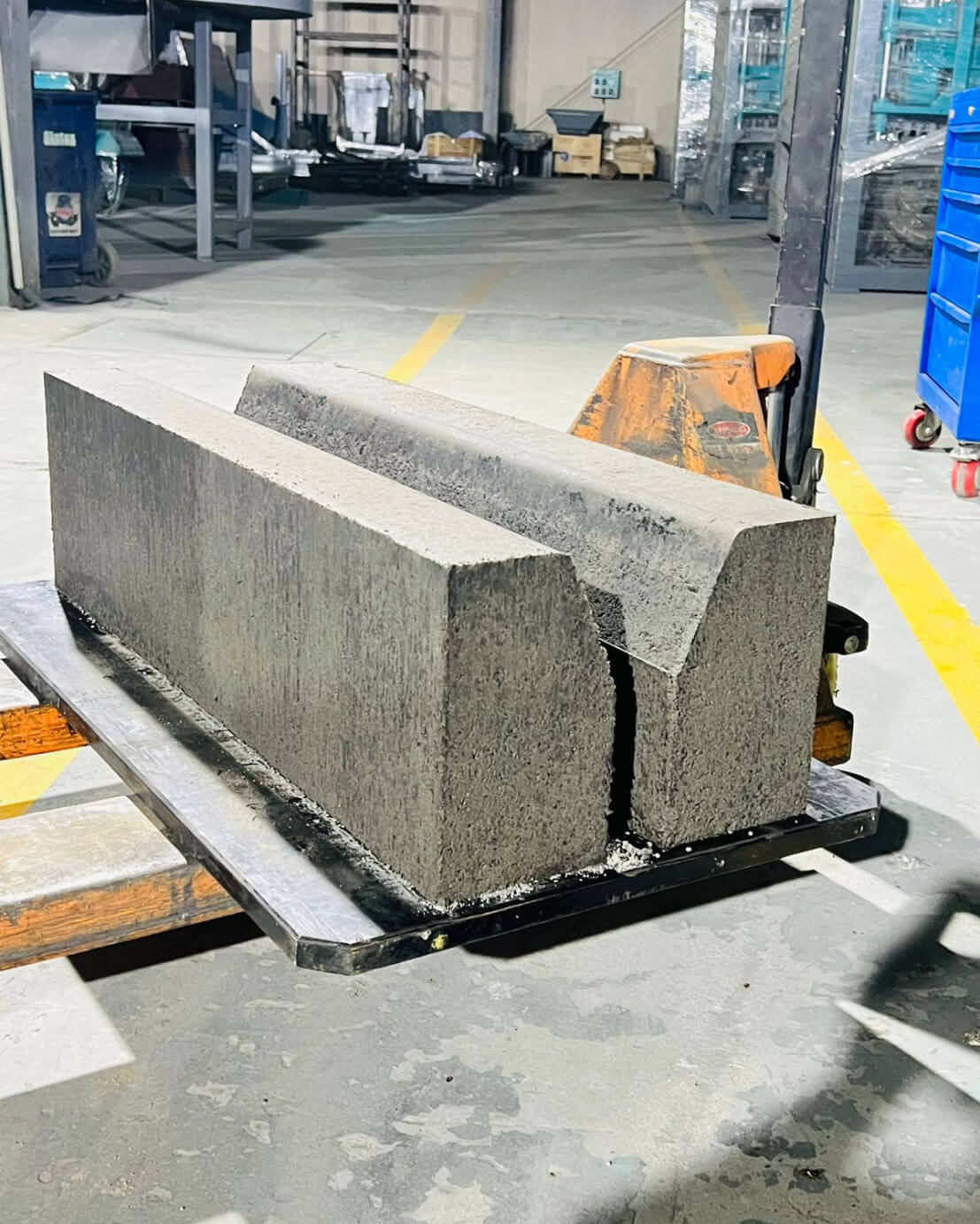
Some kerb stones do not have a perfect rectangular shape. They may have a sloped or tapered design. In such cases, the top width and bottom width may be different. This type of kerb stone is similar to a trapezoidal prism.
For trapezoidal kerb stones, use this formula:
Volume = Area of Cross Section × Length
The cross-sectional area can be calculated as:
Area = ½ × Height × (Top Width + Bottom Width)
Then:
Volume = Cross Section Area × Length
Example:
So, the volume of the trapezoidal kerb stone is:
Many kerb stones have chamfered edges for better finishing and safety. A chamfer is a small sloped cut on the edge of the stone. In such cases, the exact volume may be slightly less than a full rectangular block.
For simple project estimation, many contractors calculate the full rectangular volume and then subtract the chamfered portion if higher accuracy is required.
Basic method:
Final Volume = Rectangular Volume − Chamfer Volume
If the chamfer is very small, it may not make a major difference in bulk estimation. However, for large-scale production, accurate calculation is important because even small differences can affect total material quantity.
Kerb stone volume directly helps estimate concrete quantity. If one kerb stone has a volume of 0.045 m³, then one stone requires approximately 0.045 m³ of concrete before considering wastage.
However, in actual production, some extra concrete should be added for wastage, spillage, mold filling, and compaction loss.
Usually, 5% to 10% extra material is considered.
Example:
So, for 100 kerb stones, you may need approximately:
Many people make small mistakes while calculating kerb stone volume. These mistakes can affect the material estimate and project cost.
Common mistakes include:
To avoid these mistakes, always check the dimensions properly and use the same unit throughout the calculation.
Kerb stone volume may change depending on its design, shape, and application. Different projects require different types of kerb stones.
Important factors include:
For example, heavy-duty road kerbs usually have more volume than garden kerbs because they need greater strength and durability.
Let us take one complete example.
Kerb stone size:
Convert dimensions into meters:
Calculate volume of one kerb stone:
Now calculate the total volume:
So, for 250 kerb stones of this size, the approximate concrete requirement is:
14.175 cubic meters
Accurate volume calculation provides many benefits for construction and manufacturing work. It helps contractors prepare correct estimates and avoid unnecessary expenses.
Main benefits include:
When the volume is calculated correctly, the entire project becomes easier to manage from production to installation.