 Skip to content
Over so many years, I have encountered one common question: “How to identify a high quality block making machine?
This is an important question for every concrete product manufacturer. A concrete block making machine is not just a machine. It is the heart of your production plant. It directly affects block strength, finishing, production speed, cement consumption, manpower cost, breakage, and final profit.
Many people compare machines only by price, motor power, or production capacity. But this is not the right way. A low-cost machine may look attractive in the beginning. But if it gives poor vibration, uneven filling, high maintenance, slow cycle time, or frequent breakdowns, it can reduce your profit every day.
A high quality concrete block making machine should give strong blocks, accurate size, smooth finishing, stable output, and long machine life. It should also reduce wastage and help you produce different products like hollow blocks, solid blocks, paver blocks, kerb stones, and fly ash bricks with consistent quality.
Here are the most important points to check before selecting a concrete block making machine.
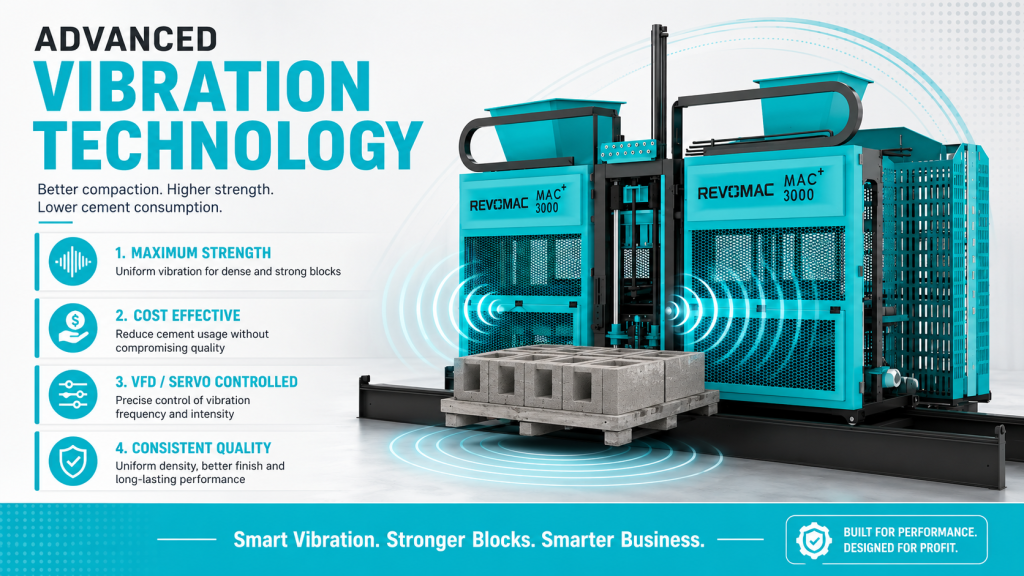
Vibration is one of the most important parts of a concrete block making machine. The real strength of a block depends on proper compaction. If the vibration system is weak, the concrete mix will not settle properly inside the mould. This can create air gaps, low density, poor finishing, and weak blocks.
Cement is one of the most expensive materials in concrete products. Many manufacturers think that adding more cement will increase strength. But this is not always true. If the vibration and compaction system is not good, even a rich mix may fail to give the required strength.
A machine with advanced vibration technology can help you get maximum strength with an optimised cement ratio. It improves density and reduces voids inside the block. This means you can control manufacturing cost while maintaining product quality.
For the best results, the vibration system should be controlled by VFD or servo motors. These systems help control vibration frequency and intensity as per product type. For example, the setting required for a paver block may be different from a hollow block. A good machine allows accurate control instead of depending on fixed vibration.
When checking a machine, do not only ask about vibration force. Also check how vibration is distributed across the mould. Uniform vibration gives uniform block strength.
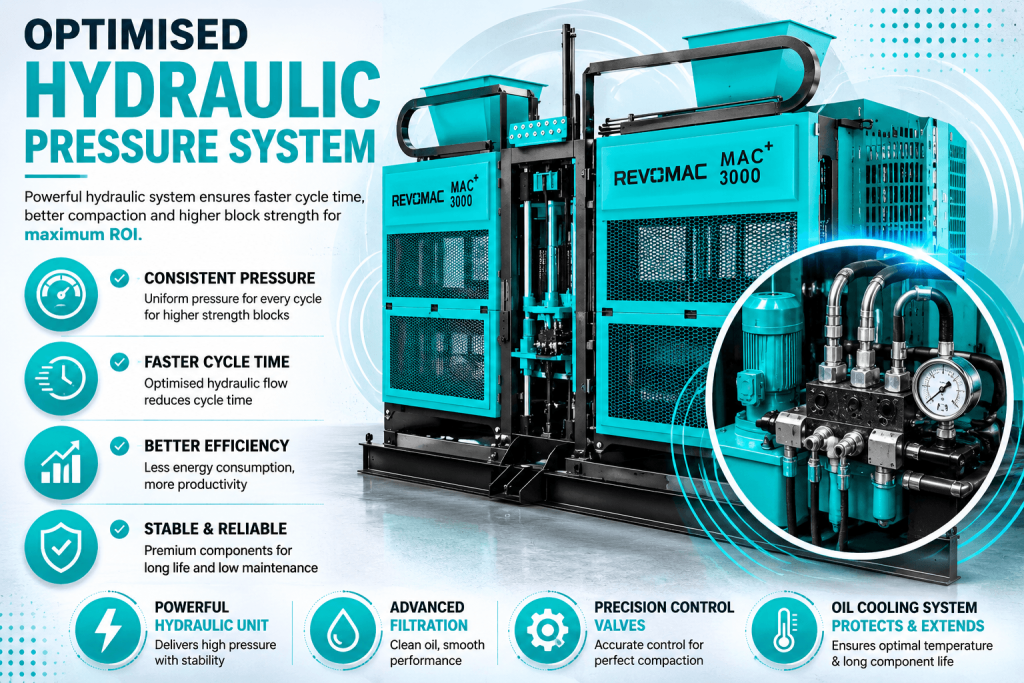
Your business ROI depends on production efficiency. One major factor behind efficiency is machine cycle time. Cycle time means how much time the machine takes to complete one production cycle.
A powerful and well-designed hydraulic system helps reduce cycle time. It gives proper pressure during moulding and helps in smooth movement of the machine parts. It also supports better compaction and faster demoulding.
But hydraulic power alone is not enough. The system should be optimised. It should provide the right pressure at the right time. Too much pressure can damage the machine or mould. Too little pressure can affect block strength and shape.
A good hydraulic system should work smoothly, without jerks and delays. It should have quality pumps, valves, cylinders, pipes, and seals. Leakage, heating, and slow movement are signs of poor hydraulic design.
Before buying a machine, check the hydraulic system layout. Ask about oil cooling, pressure control, and maintenance needs. A strong hydraulic system improves production speed, reduces downtime, and helps deliver better quality blocks.
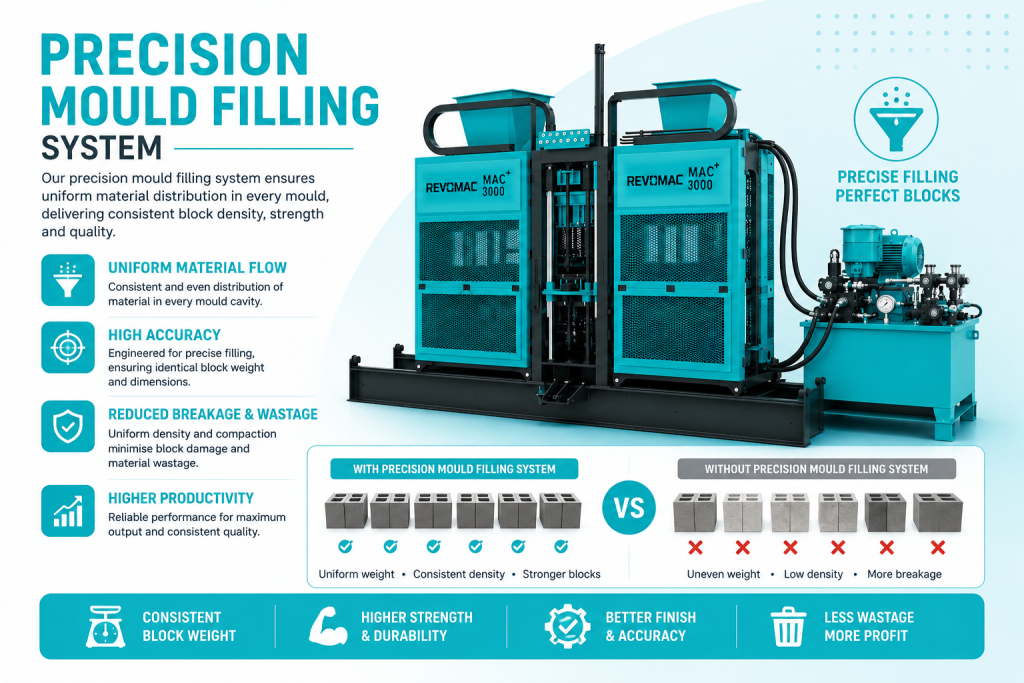
Uniform mould filling is critical in block production. If the material does not fill the mould equally, every block will not have the same weight, density, and strength.
For example, if your machine produces 20 blocks in one punch, the weight of all 20 blocks should be similar. If some blocks are lighter and some are heavier, it means filling is not uniform. This can lead to breakage, rejection, and customer complaints.
The mould filling system controls how the concrete mix enters the mould. A good filling system spreads material evenly across the mould area. It should work properly even with different mix designs and product shapes.
Poor mould filling can create weak corners, rough surfaces, uneven edges, and internal gaps. These problems may not always be visible immediately. But they can affect product performance after curing and during handling.
A high quality block making machine should have a strong feeder box, proper material flow, and accurate movement. The filling system should be designed to reduce manual adjustment and operator dependency.
When inspecting a machine, ask for a live trial. Check the weight of multiple blocks from the same punch. If the variation is low, the mould filling system is working well.
Block height accuracy is another important factor. Every block should have the same height and thickness. This is especially important for paver blocks used in pavements, roads, parking areas, footpaths, and landscaping projects.
If paver block height is not consistent, the final surface will not be level. This can create installation problems and reduce customer satisfaction. Contractors prefer paver blocks that are easy to lay and have uniform thickness.
Height variation can happen due to poor feeding, weak compaction, low machine rigidity, or inaccurate control systems. A good concrete block making machine should control height effectively during every cycle.
Height precision also matters for hollow blocks and solid blocks. If blocks are not uniform, masonry work becomes difficult. It can increase mortar consumption and reduce construction speed.
A high quality machine should have accurate height control, stable mould movement, and proper tamper head alignment. It should maintain the same height even during continuous production.
Before selecting a machine, check product samples from long production runs. Do not check only one or two blocks. Measure blocks from different cycles. This will show the real consistency of the machine.
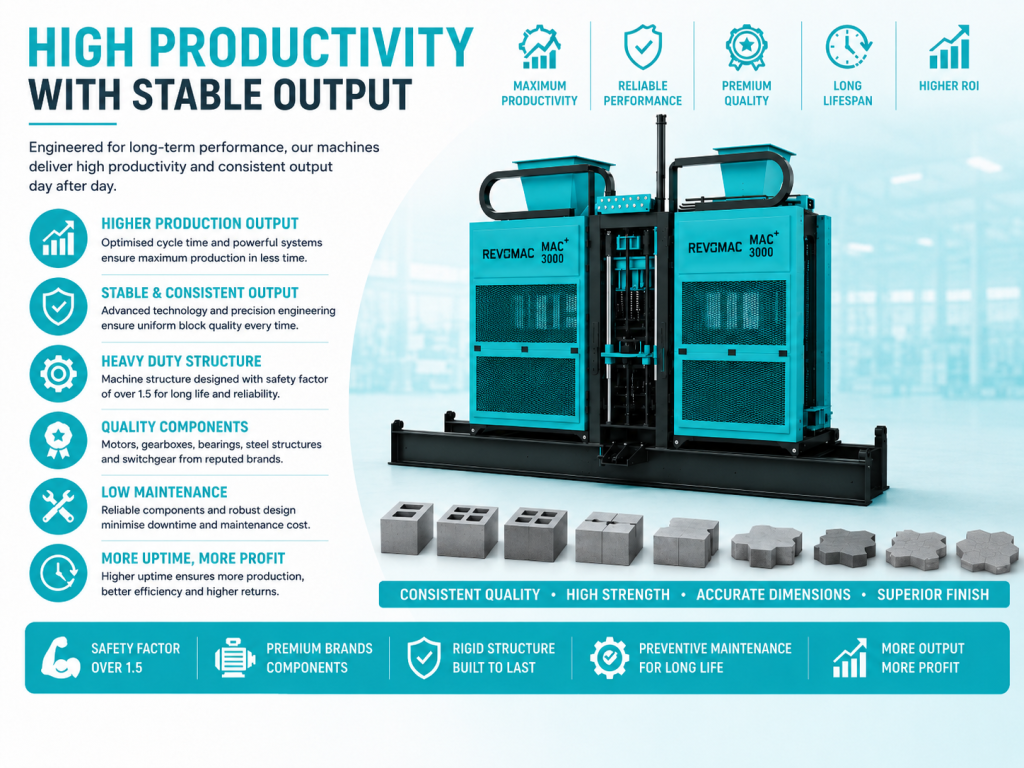
Every manufacturer wants high production. But high production is useful only when output is stable. A machine that produces fast but gives frequent breakdowns is not a good investment.
Stable output depends on machine design, structure, component quality, and preventive maintenance. The machine should be designed with a strong safety factor. Ideally, the machine structure should have a safety factor of over 1.5. This helps the machine handle vibration, pressure, load, and continuous working conditions.
A high quality machine should use motors, gearboxes, bearings, steel structures, and switchgear from reputed brands. Cheap components may reduce the initial cost, but they increase breakdown risk. They can also affect product quality and machine life.
The frame structure should be heavy and rigid. A weak structure may vibrate unnecessarily and reduce compaction efficiency. It can also affect mould life and product accuracy.
Stable productivity also depends on preventive maintenance. Even the best machine needs regular inspection, lubrication, bolt tightening, hydraulic oil checks, and mould cleaning. A good manufacturer will guide you with a maintenance schedule.
When comparing machines, do not only ask “How many blocks per hour?” Ask whether the machine can deliver that output consistently for years.
Producing blocks is only half the journey. The real challenge starts the next day, when cured blocks need to be lifted from pallets, moved to the stockyard, stacked, and prepared for dispatch.
Traditionally, this process is done manually. Workers lift blocks by hand and arrange them for storage or loading. This process is slow, labour-intensive, and prone to damage. Blocks can chip, crack, or break during handling. Manual handling also increases labour dependency.
That is why a high quality block plant should support forward integration, such as a cuber system. A cuber helps lift and stack blocks in an organised way. It reduces manual work and improves dispatch efficiency.
A cuber-supported model is useful for manufacturers who want to scale their production. It saves time, improves safety, reduces product damage, and gives a professional finish to the stockyard process.
If you are planning for future growth, do not look only at the basic machine. Think about the complete production line. Check whether the machine can be integrated with pallet handling, curing systems, conveyors, and cuber systems.
This approach helps you build a more efficient plant, not just a block making setup.
Producing blocks is only half the journey. The real challenge starts the next day, when cured blocks need to be lifted from pallets, moved to the stockyard, stacked, and prepared for dispatch.
Traditionally, this process is done manually. Workers lift blocks by hand and arrange them for storage or loading. This process is slow, labour-intensive, and prone to damage. Blocks can chip, crack, or break during handling. Manual handling also increases labour dependency.
That is why a high quality block plant should support forward integration, such as a cuber system. A cuber helps lift and stack blocks in an organised way. It reduces manual work and improves dispatch efficiency.
A cuber-supported model is useful for manufacturers who want to scale their production. It saves time, improves safety, reduces product damage, and gives a professional finish to the stockyard process.
If you are planning for future growth, do not look only at the basic machine. Think about the complete production line. Check whether the machine can be integrated with pallet handling, curing systems, conveyors, and cuber systems.
This approach helps you build a more efficient plant, not just a block making setup.
The mould is the part that gives shape to your final product. Even if the machine is powerful, poor mould quality can spoil the output.
A good mould should be made from high-quality steel. It should have accurate dimensions, proper hardness, and long wear life. The mould should also support clean edges and smooth finishing.
Product flexibility is also important. A good machine should allow you to produce different products by changing moulds. This can include hollow blocks, solid blocks, paver blocks, kerb stones, and other concrete products.
This flexibility helps you serve different market needs. You can change products based on demand instead of investing in separate machines for every product.
Before buying, ask how much time it takes to change the mould. Also check whether mould alignment is easy and accurate. A difficult mould changing process can reduce productivity.
Automation helps reduce human error. A good control system allows the operator to manage cycle time, vibration, pressure, feeding, and production settings more accurately.
The control panel should be simple and user-friendly. Operators should be able to change settings as per product type. The system should also have safety features to protect the machine and workers.
PLC-based control systems are useful for consistent production. They help maintain repeatable cycles and reduce manual dependency.
A high quality machine should not be difficult to operate. It should be advanced, but practical. Your operator should be able to learn the system quickly and run production with confidence.
A block making machine is a long-term investment. So after-sales support is very important. Even a strong machine may need service, spares, or technical support over time.
Before choosing a manufacturer, check their service network. Ask about spare parts availability, technician support, installation, training, and maintenance guidance.
A machine with poor support can stop your production for days. This can cause loss of orders, labour cost, and customer trust.
A reliable manufacturer will not only sell the machine. They will also help you run it successfully.