 Skip to content
Paver blocks are widely used for driveways, walkways, parking areas, industrial floors, gardens and public spaces. Their strength and durability depend on several factors, including the type of cement, aggregate quality, water-cement ratio, compaction and curing.
One of the most common questions asked by paver manufacturers is: what type of cement is used for pavers?
In India, different types of cement can be used for concrete paving blocks. These include Ordinary Portland Cement (OPC) 43 Grade, OPC 53 Grade, Portland Pozzolana Cement (PPC), Portland Slag Cement (PSC) and rapid-hardening cement, provided the cement and finished blocks meet the applicable standards and performance requirements. IS 15658 has historically recognised multiple cement types for precast concrete paving blocks.
However, for commercial paver block manufacturing, OPC 43 and OPC 53 are among the commonly considered options. The right choice depends on the required strength, production cycle, application and concrete mix design.
Paver blocks are made from a carefully controlled concrete mixture containing cement, aggregates, water and, where required, admixtures or pigments.
The cement acts as the binding material. When cement reacts with water, it creates a hardened matrix that holds the aggregates together. This process gives the paver block its strength and structural stability.
Different cement types may be suitable depending on the manufacturing process.
Common choices include:
OPC 43 Grade
OPC 53 Grade
Portland Pozzolana Cement
Portland Slag Cement
Rapid-hardening Portland cement
Indian paving-block specifications have permitted OPC as well as PPC and PSC, subject to compliance with relevant cement standards.
Choosing cement should therefore not be based only on the number written on the cement bag. The required concrete strength, curing system, production speed and exposure conditions must also be considered.
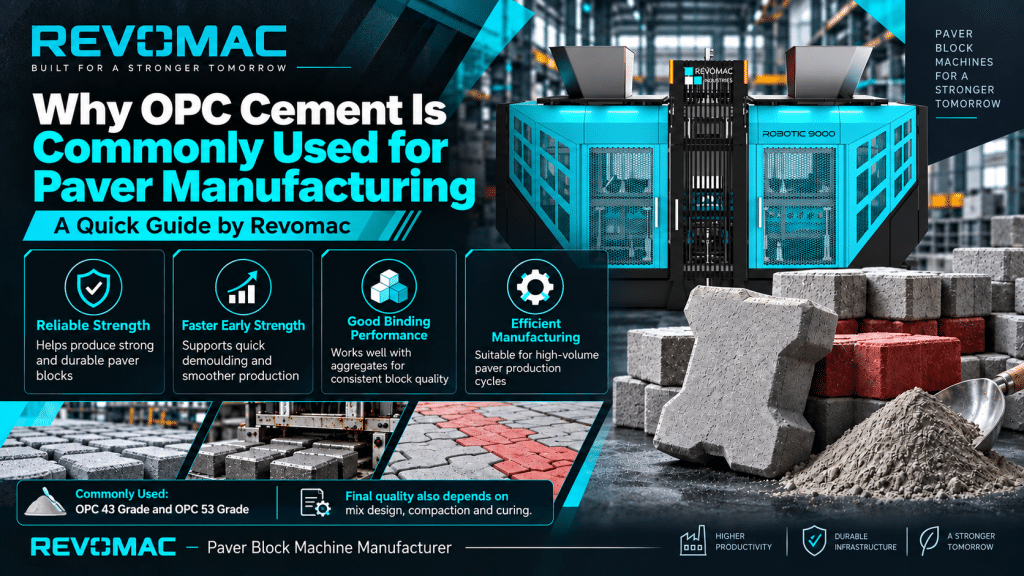
Ordinary Portland Cement is widely associated with precast concrete products because it can provide predictable strength development and relatively fast early strength.
This is especially useful for commercial paver production.
Paver manufacturers often need to:
Demould products quickly
Maintain consistent production cycles
Achieve the required compressive strength
Reduce breakage during handling
Move finished blocks into curing and storage efficiently
OPC can be suitable for these requirements when the concrete mix is properly designed.
However, using a higher cement grade does not automatically produce a better paver. Concrete strength depends on the entire mix, including aggregate grading, cement quantity, water-cement ratio, vibration, compaction and curing.
For this reason, manufacturers should treat cement selection as one part of the complete manufacturing process.

OPC 43 and OPC 53 are two commonly discussed cement grades for concrete products.
The main difference relates to their specified strength characteristics.
OPC 43 offers good strength and is suitable for many general concrete applications.
For paver manufacturers, it may work well where extremely rapid early-strength development is not essential.
Some potential advantages include:
OPC 53 develops higher early strength and is often selected for precast concrete and high-strength applications where faster production cycles are required. Current construction guidance commonly positions OPC 53 for precast and higher-strength concrete applications.
Possible benefits for paver production include:
Faster early strength gain
Earlier handling of manufactured blocks
Suitability for higher-strength concrete
Faster production cycles when properly controlled
However, OPC 53 should not simply be added in excessive quantities. The concrete mix must still be designed correctly.
In commercial production, the decision between OPC 43 and OPC 53 should therefore depend on the target paver grade, curing method and manufacturing cycle rather than assuming that 53 Grade is always better.
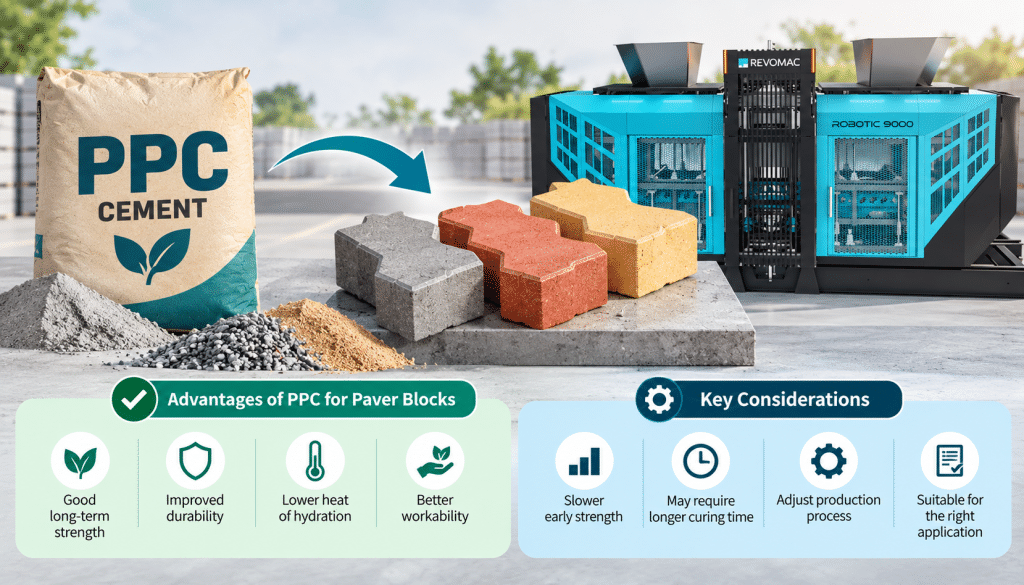
Yes. Portland Pozzolana Cement can be used in concrete paving blocks when the mix and curing process are designed appropriately.
IS 15658 has included fly-ash-based and calcined-clay-based Portland Pozzolana Cement among permitted cement types for paving blocks.
PPC typically develops early strength more slowly than OPC 53, but it can provide strong long-term performance.
Advantages may include:
The main consideration for a paver manufacturer is production time.
Because PPC can gain strength more slowly in the early stages, manufacturers may need to allow enough curing time before heavy handling, transportation or testing.
Therefore, PPC can be a practical option, but the manufacturing process should be adjusted accordingly.

Cement grade influences strength development, but it is only one factor affecting the final quality of a paver block.
A common mistake is believing that using OPC 53 automatically produces a 53 MPa paver.
That is not how concrete strength works.
The numbers 43 and 53 describe cement-grade strength characteristics under standard testing conditions. They do not directly represent the compressive strength of the finished concrete product.
Paver strength depends on:
Setting behaviour and early strength are particularly important in paver block manufacturing because pavers are generally produced in large quantities.
A fast and controlled production cycle can improve manufacturing efficiency.
After moulding and vibration, the paver needs enough initial strength to maintain its shape and resist damage during handling.
If strength develops too slowly, manufacturers may experience:
This is one reason OPC 53 may be attractive for manufacturers who require faster early strength.
However, faster strength gain should never replace proper curing.
Even high-strength cement needs enough moisture and curing time for proper hydration. Poor curing can reduce strength, increase surface cracking and shorten the service life of the paver.
A controlled curing system is therefore just as important as cement selection.
There is no single cement type that is automatically best for every paver block manufacturer.
The correct cement should be selected based on the required application and production conditions.
Before choosing cement, consider the following factors:
Required paver strength: Heavy-duty industrial or vehicle-loading areas may require higher-strength paving blocks than garden pathways or pedestrian areas.
Production speed: Manufacturers requiring fast demoulding and handling may prefer a cement with stronger early-strength development.
Concrete mix design: Cement must work effectively with the selected aggregates, water content and admixtures.
Curing system: The cement choice should match the available curing time and method.
Durability requirements: Consider weather exposure, traffic, abrasion and water absorption.
Cost efficiency: The most expensive cement is not automatically the most economical choice. A properly designed mix should achieve the required performance with efficient material consumption.
Applicable standards: Finished pavers should comply with the relevant strength, dimensional, abrasion and water-absorption requirements.
The current IS 15658 specification includes requirements covering factors such as water absorption, compressive strength, abrasion resistance and tensile splitting strength.
Revomac is a trusted paver block machine manufacturer offering advanced and efficient machinery for high-quality paver production. Its machines are designed for consistent output, strong compaction, smooth operation, durability, and reliable performance for concrete product manufacturers.