 Skip to content
The concrete block manufacturing business can be a profitable opportunity when it is planned and managed correctly. Demand for concrete blocks, paver blocks, hollow blocks, fly ash bricks, and other precast products continues to come from residential, commercial, industrial, and infrastructure projects.
However, buying a block-making machine does not automatically create a successful block manufacturing business.
Some manufacturers build profitable operations and expand production over time. Others struggle with low sales, poor product quality, high operating costs, and cash flow problems.
So, what creates the difference?
According to Jigar Patel from Revomac Industries, many block manufacturing businesses face problems because important business factors are overlooked before production begins.
Here are five major reasons why block industries fail and what entrepreneurs should consider before investing in a concrete block manufacturing business.
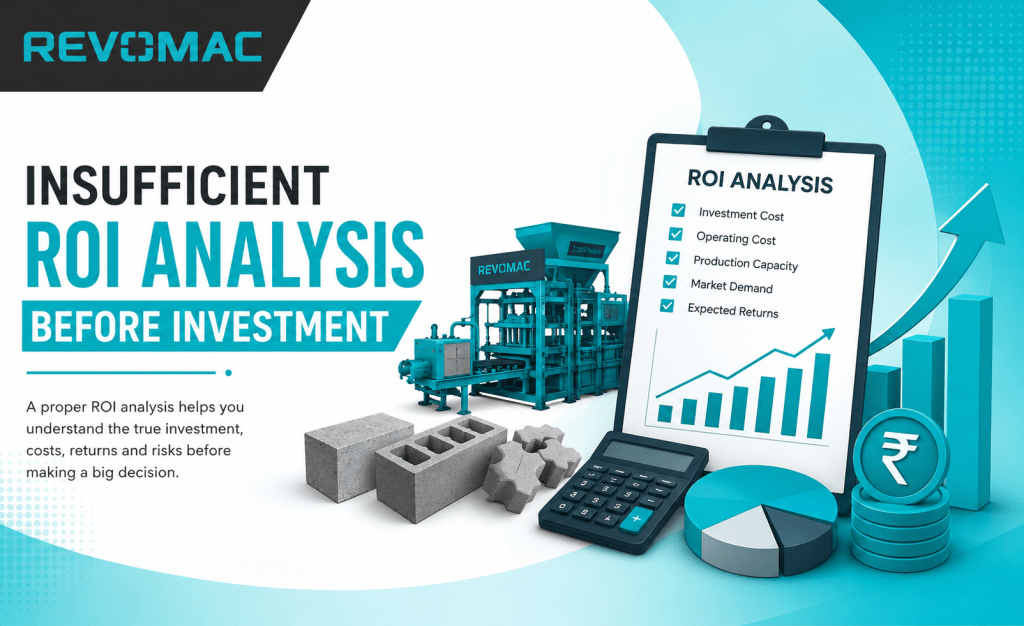
One of the first mistakes is investing without conducting a proper Return on Investment (ROI) analysis.
Entrepreneurs sometimes focus mainly on the cost of the block-making machine. However, machine cost is only one part of the total investment.
A proper financial calculation should consider factors such as:
Production capacity must also be compared with realistic market demand.
For example, a machine may technically produce thousands of blocks every day. But if the local market can absorb only a portion of that production, the machine may remain underutilised.
That directly affects the expected return on investment.
Before setting up a plant, entrepreneurs should calculate the approximate manufacturing cost per block and compare it with the expected selling price.
They should also estimate how many blocks need to be sold every month to cover fixed and variable expenses.
A realistic ROI analysis helps answer an important question:
Will this investment generate sustainable profits under actual market conditions?
Making this calculation before purchasing machinery can prevent costly investment decisions later.
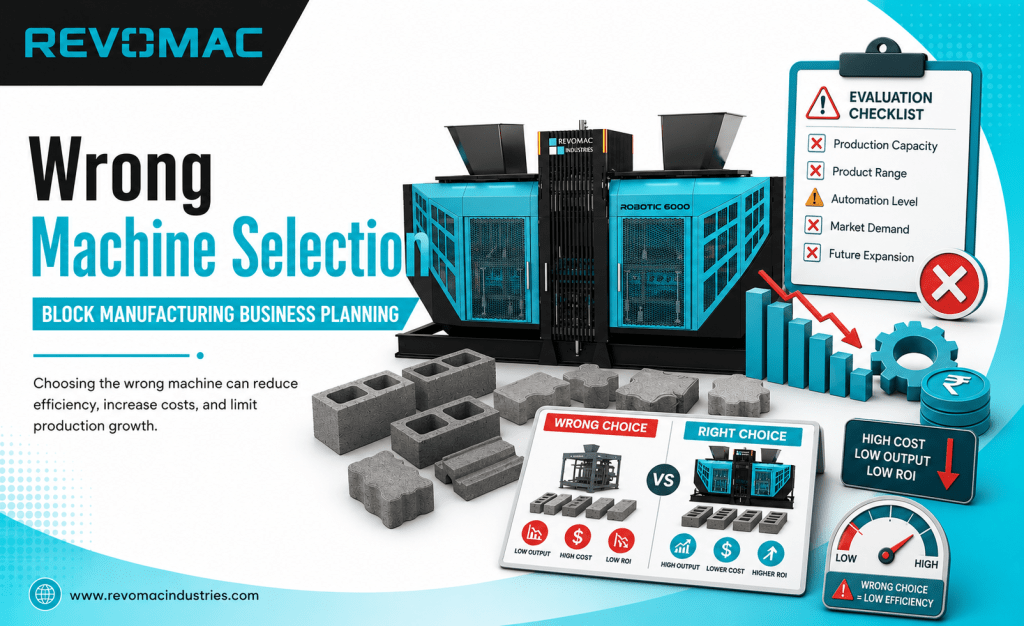
Machine selection plays a major role in the performance of a block manufacturing plant.
A common mistake is choosing a machine based mainly on price.
The cheapest machine may not provide the required production capacity, automation level, product quality, or long-term reliability.
At the same time, purchasing a very high-capacity machine without sufficient market demand can create unnecessary financial pressure.
The correct machine should be selected according to the actual requirements of the business.
Entrepreneurs should consider:
Different markets may demand different products.
One location may have strong demand for concrete pavers, while another may require hollow blocks or solid concrete blocks.
The machine should therefore support the product range that has genuine sales potential in the target market.
Entrepreneurs should also consider whether they need a manual, semi-automatic, or fully automatic block-making plant.
A properly selected machine improves production efficiency and helps control operating costs.
Working with an experienced block machine manufacturer such as Revomac Industries can also help investors understand which machine configuration is suitable for their planned production capacity and product range.
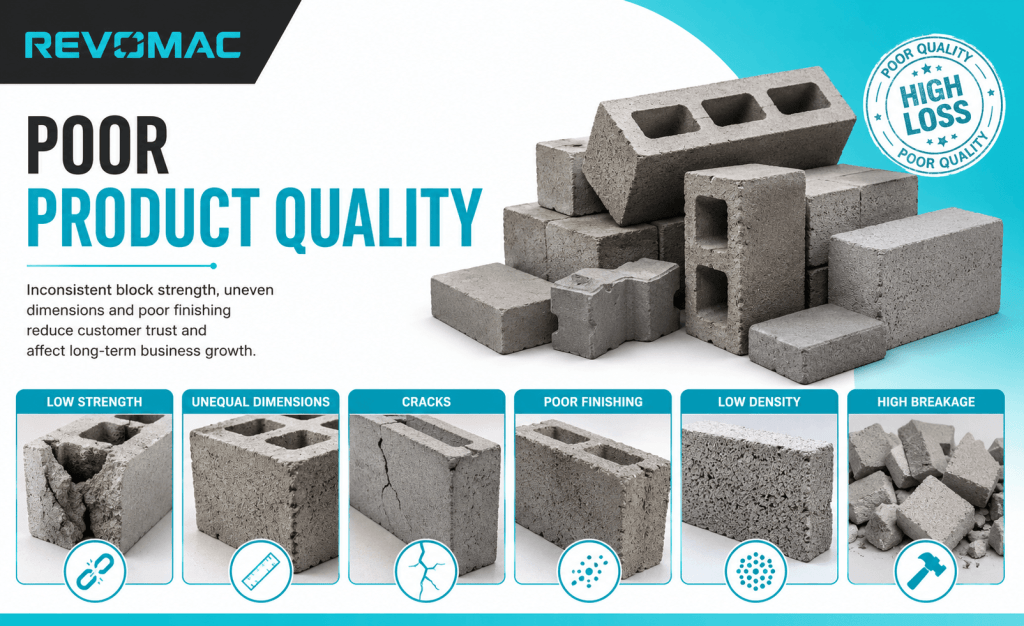
Getting blocks out of a machine is not the same as producing a marketable product. Customers expect concrete blocks to meet consistent standards for strength, dimensions, surface finish, and durability. Poor product quality can quickly damage the reputation of a new block manufacturer.
Getting blocks out of a machine is not the same as producing a marketable product. Customers expect concrete blocks to meet consistent standards for strength, dimensions, surface finish, and durability. Poor product quality can quickly damage the reputation of a new block manufacturer.
Using the correct proportion of ingredients is critical. Using too little cement may reduce strength, while an incorrect moisture level can affect compaction and finishing.
Raw materials should be mixed uniformly before entering the machine. Inconsistent mixing can create variations between one batch and another.
Vibration, pressure, feeding, and compaction should remain consistent throughout production. Well-designed machinery helps manufacturers achieve repeatable results.
Concrete products continue developing strength after production. Poor curing can result in weak blocks even when the initial manufacturing process was correct. Maintaining product quality helps manufacturers reduce rejection rates and build stronger relationships with contractors, builders, dealers, and distributors. Customers who receive consistent products are also more likely to place repeat orders.
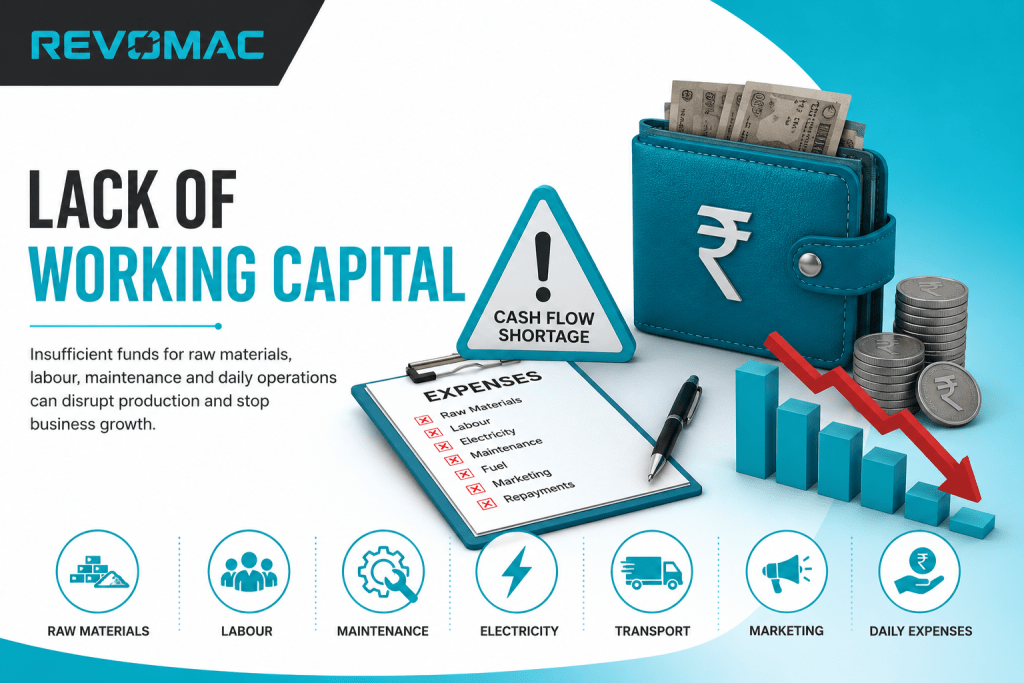
Another major reason block manufacturing businesses struggle is insufficient working capital.
Entrepreneurs sometimes spend most of their available budget on machinery and factory setup.
After installation, they realise that significant funds are still required to operate the plant every day.
Working capital is needed for:
There can also be a delay between manufacturing products and receiving payment from customers.
For example, a manufacturer may need to purchase raw material immediately but provide 30-day or 60-day credit to dealers or construction companies.
This creates a cash flow gap.
Even a profitable business can face serious problems when there is not enough cash available to manage daily operations.
Entrepreneurs should therefore keep working capital separate from the initial machinery investment.
They should estimate how much money will be required to operate the plant for the first few months.
A financial buffer can help the business continue operating while the customer base is being developed.
Proper cash flow management is just as important as production capacity.
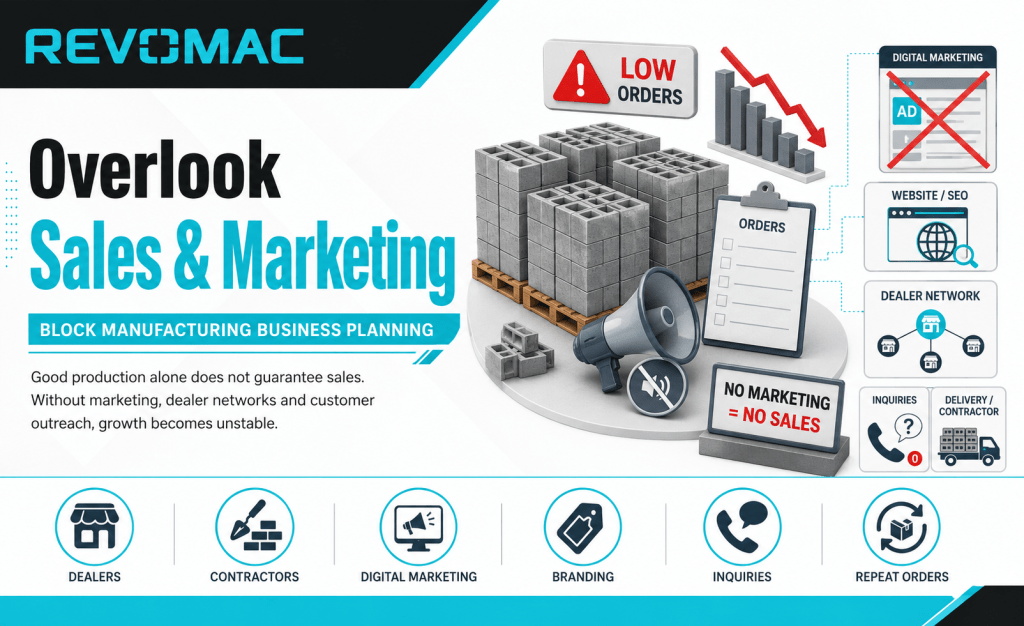
Many entrepreneurs spend months planning their factory, machinery, raw materials, and production.
But one critical question is sometimes asked too late:
Who will buy the blocks?
Manufacturing large quantities of concrete blocks does not guarantee that they will be sold.
A block manufacturing plant needs a strong sales strategy before production begins.
Potential customers may include:
Before starting production, manufacturers should study their local market.
Identify what products are already selling, which block sizes are preferred, what competitors charge, and what problems customers currently face.
The findings can help determine the right product mix and pricing strategy.
A block-making machine is an important part of the business, but it is only one part of a complete manufacturing system.
Successful block manufacturing businesses usually combine several factors:
Right Investment + Right Machine + Quality Production + Working Capital + Strong Sales
Ignoring even one of these areas can create difficulties.
For example, an excellent machine cannot solve a weak sales strategy.
Strong market demand cannot compensate for poor block quality.
Good product quality cannot keep the factory running if there is no working capital.
Each part of the business needs to support the others.