 Skip to content
In concrete block manufacturing, consistency is one of the most important factors behind good product quality. A block may look simple from the outside, but producing thousands of blocks with the same strength, size, density, and finish requires careful control at every stage.
This is where uniformity becomes important.
A modern block making machine must maintain consistent vibration, material filling, product height, compaction, and water-cement ratio throughout production. Even a small variation in one of these areas can affect the final block quality.
For manufacturers producing concrete blocks, hollow blocks, solid blocks, paver blocks, or other precast products, maintaining uniformity can help improve quality while reducing waste, rejection, and production problems.
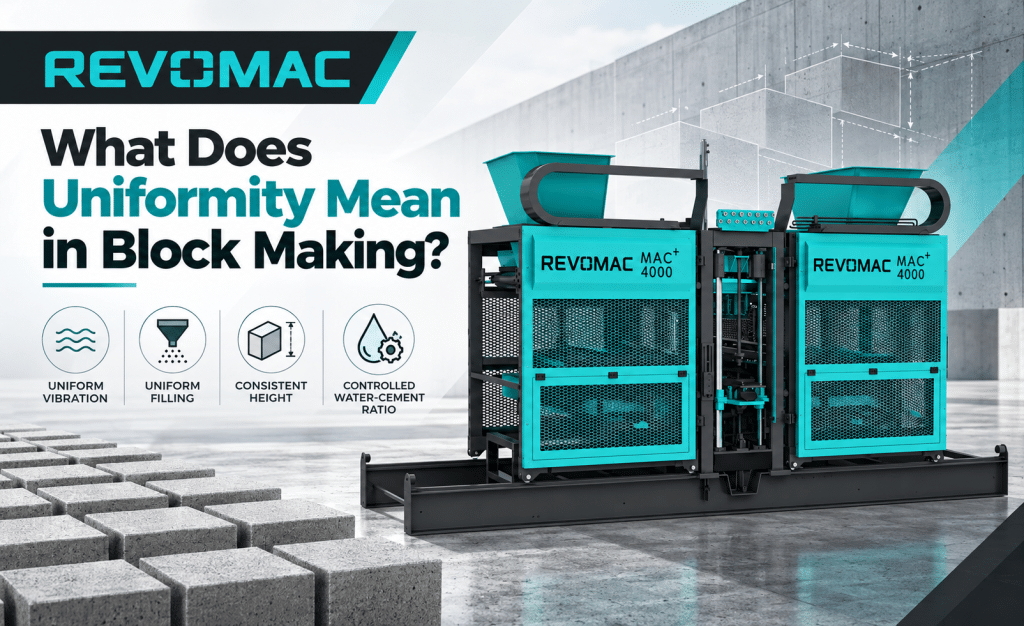
Uniformity means maintaining the same production conditions for every mould cycle and every batch.
Each block should receive almost the same amount of material, vibration, pressure, moisture, and compaction. The final blocks should also have consistent dimensions and density.
When these factors remain controlled, manufacturers can produce blocks with more predictable performance.
Without proper uniformity, one batch may produce strong and well-shaped blocks while another batch may have problems such as cracks, uneven surfaces, incorrect dimensions, or lower strength.
That is why consistency should be considered throughout the complete manufacturing process.

Vibration is one of the most important processes in a block making machine.
Once the concrete mixture enters the mould, vibration helps the material settle properly. It reduces unwanted air spaces and allows the concrete particles to arrange themselves more closely.
However, vibration should be distributed evenly throughout the mould.
If one section receives more vibration than another, block density may become uneven. Some areas of the block may become properly compacted while other areas remain weak or porous.
Uniform vibration helps achieve:
A properly designed vibration system therefore plays an important role in producing reliable concrete blocks.
Every mould cavity should receive a controlled and consistent quantity of concrete mixture.
Uneven filling can create major differences between finished blocks.
For example, if one cavity receives more material than another, the blocks may vary in weight, height, density, and strength. This problem becomes even more noticeable during continuous high-volume production.
A controlled material feeding system helps distribute the mixture evenly across the mould.
Uniform filling supports:
Material distribution becomes especially important when producing multiple blocks during a single machine cycle.
The goal is to ensure that every mould section receives nearly the same amount of material before vibration and compaction begin.
Block dimensions are extremely important in construction.
If block height varies from one unit to another, it can create problems during transportation, stacking, and installation.
Construction workers expect blocks to have consistent dimensions so they can maintain proper alignment while building walls or other structures.
A reliable block making machine should therefore control product height during every production cycle.
Uniform block height provides several benefits.
It improves stacking, reduces alignment problems, creates cleaner masonry work, and helps maintain a professional finished appearance.
Dimensional consistency can also reduce the need for additional mortar adjustments during installation.
For manufacturers, accurate product dimensions can improve customer satisfaction and reduce product rejection.

The water-cement ratio directly affects the behaviour and performance of the concrete mixture.
If too much water is added, the mixture may become too wet. This can affect block shape, early strength, surface finish, and handling.
If too little water is added, proper compaction may become difficult.
For this reason, manufacturers should maintain a controlled and repeatable moisture level.
A consistent water-cement ratio helps support:
The correct ratio depends on the raw materials, product type, cement characteristics, aggregates, and production requirements.
The important point is to avoid unnecessary variation between batches.

Density is another major quality factor in concrete block manufacturing.
Two blocks may have the same external dimensions but different internal density levels.
If the concrete mixture is poorly distributed or insufficiently compacted, certain areas may contain more voids. These areas can reduce the overall strength and durability of the product.
Uniform vibration and material filling work together to create more consistent density throughout the block.
When density remains stable, manufacturers can achieve more reliable performance from one production cycle to another.
Consistent density also makes it easier to monitor product quality and maintain production standards.
Every rejected block represents wasted raw material, production time, energy, labour, and machine capacity.
Common reasons for block rejection can include:
Improving production uniformity can help reduce many of these problems.
When the machine repeatedly performs each cycle under controlled conditions, the number of defective or inconsistent products can be reduced.
This can improve overall production efficiency and help manufacturers make better use of their raw materials.
Uniformity is not only about product quality. It can also improve production efficiency.
When filling, vibration, compaction, and product dimensions remain consistent, machine operators need fewer manual adjustments.
Production becomes more predictable.
Manufacturers can also reduce stoppages caused by incorrect filling, damaged products, or quality variation.
A stable production process helps improve output while making it easier for operators to monitor machine performance.
For high-capacity block manufacturing plants, even small improvements in consistency can create a significant difference over thousands of production cycles.
Modern block making machines are designed to provide better control over critical production parameters.
Depending on the machine configuration, manufacturers can control factors such as material feeding, vibration, moulding, compaction, product height, and production cycle timing.
Automation can further reduce variations caused by manual handling.
However, machines alone cannot guarantee quality.
Raw material quality, mix design, moisture control, mould condition, operator knowledge, machine maintenance, and curing also influence the final product.
The best results come from controlling the complete manufacturing process.
Revomac Industries develops block-making solutions designed to support controlled production, consistent output, and efficient manufacturing.
Our machines are suitable for producing products such as concrete blocks, hollow blocks, solid blocks, paver blocks, and other precast concrete products.
By focusing on areas such as uniform vibration, material feeding, compaction, and dimensional accuracy, manufacturers can improve the repeatability of their production process.
The objective is not simply to produce more blocks. It is to produce blocks with consistent quality across every production cycle.