 Skip to content
Short answer: We installed a fully automatic MAC 1800 block making machine, with a batching plant and cement silo, for Shreesha Greentech in Bengaluru, Karnataka. The client set up the plant to meet construction material demand from Indian Oil Corporation Limited (IOCL). The same line produces M10 grade concrete bricks and blocks and M40 grade paver blocks.
Shreesha Greentech, based in Bengaluru, needed one plant that could make two very different products to a stated grade. That is a common brief when you supply a large buyer like IOCL.
This case study explains what we installed, why the plant was set up this way, and what other plant owners can learn from it.
| Item | Detail |
|---|---|
| Client | Shreesha Greentech, Bengaluru |
| Location | Bengaluru, Karnataka |
| End demand | Construction material needs of Indian Oil Corporation Limited (IOCL), supplied by the client |
| Machine | Revomac MAC 1800, fully automatic |
| Plant equipment | Batching plant and cement silo |
| Products | M10 grade concrete bricks and blocks; M40 grade paver blocks |
| Installed by | Revomac Industries, Ahmedabad |
A note on roles: Shreesha Greentech is the supplier to IOCL. Revomac supplied and installed the machine for Shreesha Greentech.
The client’s products fall into two groups with very different strength targets.
M10 bricks and blocks. “M10” means a characteristic compressive strength of 10 N/mm² at 28 days. For comparison, IS 2185 (Part 1) sets 4.0 N/mm² as the starting grade for solid load-bearing blocks. So M10 blocks sit well above that minimum.
M40 paver blocks. Under IS 15658:2021, M40 pavers are the grade for medium traffic, such as city streets. The minimum thickness for this grade is 80 mm. That is four times the strength target of the M10 blocks.
| What matters | M10 bricks and blocks | M40 paver blocks |
|---|---|---|
| Strength target | 10 N/mm² at 28 days | 40 N/mm² (IS 15658 grade for medium traffic) |
| Governing standard | IS 2185 (Part 1) for concrete blocks | IS 15658:2021 for paver blocks |
| Minimum thickness | Set by block size | 80 mm for M40 |
| Mix design | Leaner mix, lower cement content | Richer, tightly controlled mix |
| Machine priority | Uniform mould filling, steady cycle time | Height precision, strong compaction, consistent vibration |
Running both on one line means the plant must switch between mix designs and moulds without losing accuracy.
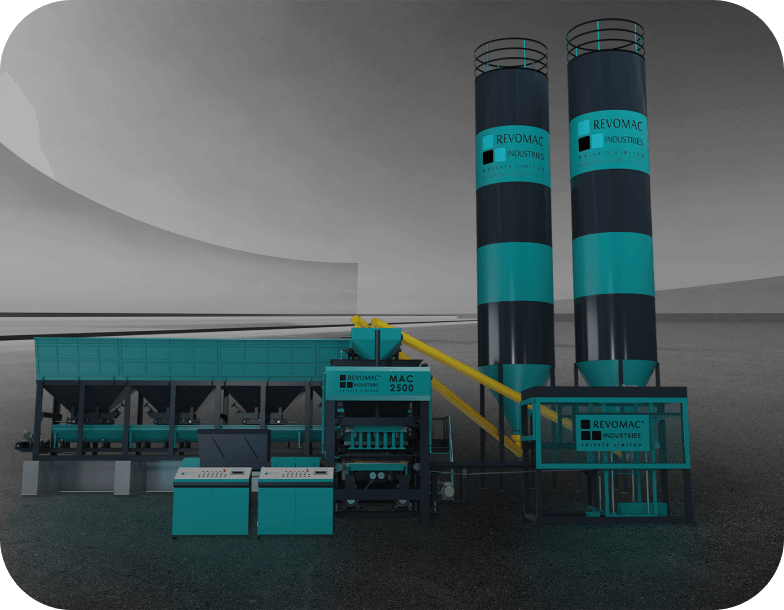
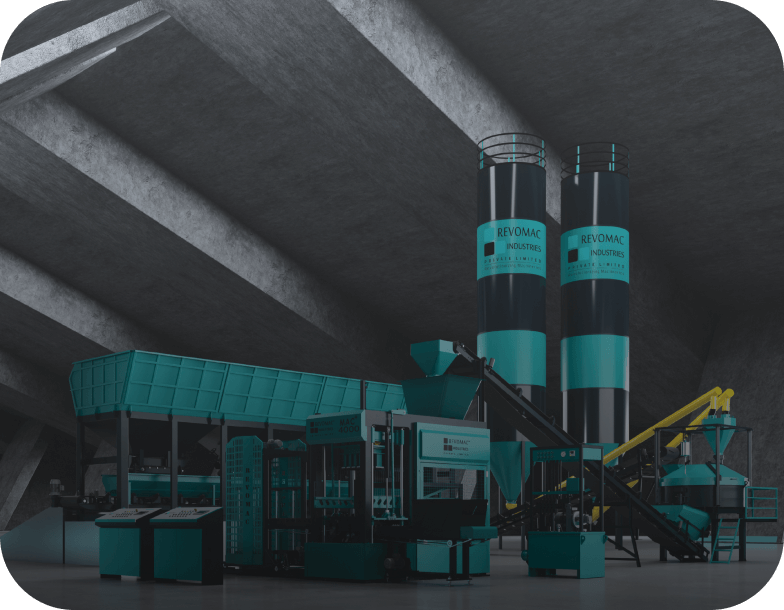
MAC 1800, fully automatic. The MAC 1800 is part of our MAC series, alongside the MAC 1400 and MAC 2500. Full automation keeps cycle time and compaction the same shift after shift. That consistency matters when every batch has to meet a named grade.
Batching plant. A weigh batching plant measures cement, aggregates and water by weight for every batch. Switching from an M10 mix to an M40 mix becomes a recipe change, not guesswork by the operator. It also stops cement being overdosed “to be safe”, which raises cost.
Cement silo. A silo stores bulk cement and feeds the batching plant directly. Bag handling and bag waste go down. Cement supply to the mixer stays steady during long runs.
Our design checks for a plant like this include uniform mould filling, so blocks from one cycle weigh the same. They also include height precision control, which is critical for pavers. You can read more in our guide on how to choose a high-quality block making machine.
We supplied and installed the MAC 1800 plant for Shreesha Greentech in Bengaluru. Shreesha Greentech supplies construction material to meet IOCL’s demand.
M10 means a characteristic compressive strength of 10 N/mm² at 28 days. It is well above the 4.0 N/mm² starting grade for solid load-bearing blocks in IS 2185 (Part 1).
IS 15658:2021 lists M40 for medium traffic, such as city streets. The minimum thickness for M40 pavers is 80 mm.
Yes. With the right moulds and mix designs, the MAC 1800 makes both. A batching plant makes switching between mixes accurate.
Weigh batching gives the same mix every batch, which helps you hit a named grade. A silo stores bulk cement and keeps supply to the mixer steady.
Yes. This plant is in Karnataka, and we also export to Gulf, African and South American countries.
Tell us the products and grades you need, your target output and your site location. We will suggest a machine and plant layout to match. Contact Revomac →
Related machines: brick making machine · solid block making machine
