 Skip to content
Short answer: A solid concrete block machine compacts a cement, aggregate and water mix in a steel mould using vibration and pressure. In India it usually makes 400 × 200 mm blocks in 100, 150 or 200 mm widths. Output per hour equals blocks per cycle × cycles per hour. Price depends mainly on automation, mould size, vibration system, batching, handling equipment and power.
Solid blocks are the most common product we see on new block plants. They are simple to sell, easy to stack and used in almost every wall.
This guide covers the block sizes buyers ask for and how to check a machine’s real output. It also explains what changes the price. We have built these machines since 2010.
Solid concrete blocks in India are covered by IS 2185 (Part 1): 2005. Here are the points that affect your machine choice.
The ±3 mm height tolerance is why height control on the machine matters. A machine that cannot hold height will make blocks you cannot sell as IS 2185 blocks.
Most Indian buyers ask for three sizes. They share a 400 × 200 mm face and change only in width.
| Size (L × H × W, mm) | Common name | Typical use | Approx. weight at 2,100 kg/m³ |
|---|---|---|---|
| 400 × 200 × 100 | 4 inch block | Partition and internal walls | 16.8 kg |
| 400 × 200 × 150 | 6 inch block | Internal and some external walls | 25.2 kg |
| 400 × 200 × 200 | 8 inch block | External and load-bearing walls, compound walls | 33.6 kg |
Weights are worked out from volume × an assumed density of 2,100 kg/m³. Your actual weight depends on your mix. Some sellers also list 600 × 200 mm faces and 390 × 190 mm sizes, so ask your buyers before you order moulds.
Output claims on listings often do not add up. You can check any claim with one formula.
Blocks per hour = blocks per cycle × (3,600 ÷ cycle time in seconds)
Blocks per cycle depends on the mould: how many cavities fit on one pallet for that block size. Cycle time is the time for one full fill, vibrate, compress and eject. It depends mostly on the hydraulic system and vibration.
Then allow for real-world losses: mould cleaning, pallet jams, mixer waits and breaks. Many plants plan at about 85% of theoretical output.
Here is a worked example. The cavities, cycle time and efficiency below are example figures only, not the specification of any Revomac model.
| Block size (mm) | Example blocks per cycle | Cycles per hour at 20 s | Theoretical blocks per hour | At 85% efficiency | Per 8-hour shift |
|---|---|---|---|---|---|
| 400 × 200 × 100 | 10 | 180 | 1,800 | 1,530 | 12,240 |
| 400 × 200 × 150 | 7 | 180 | 1,260 | 1,071 | 8,568 |
| 400 × 200 × 200 | 5 | 180 | 900 | 765 | 6,120 |
Two things stand out. First, wider blocks mean fewer blocks per cycle, so always ask for output by block size. Second, cutting cycle time from 20 s to 15 s raises output by a third with the same mould.
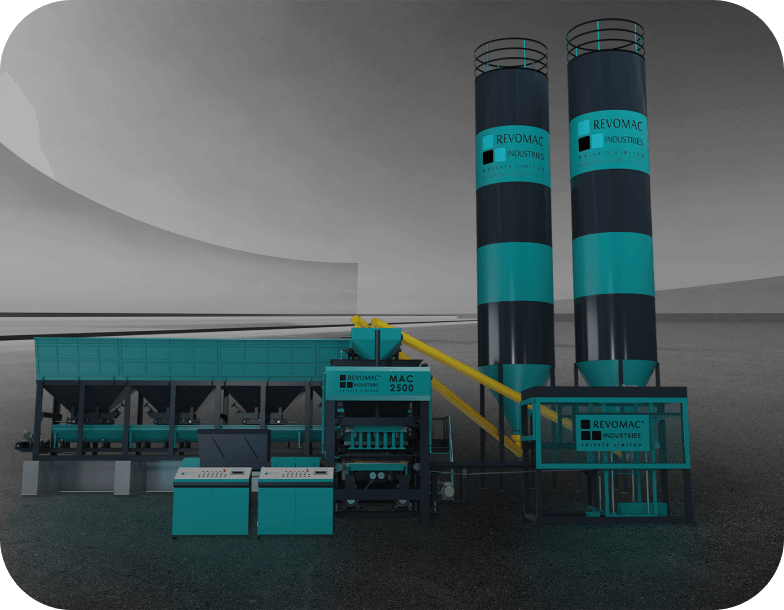
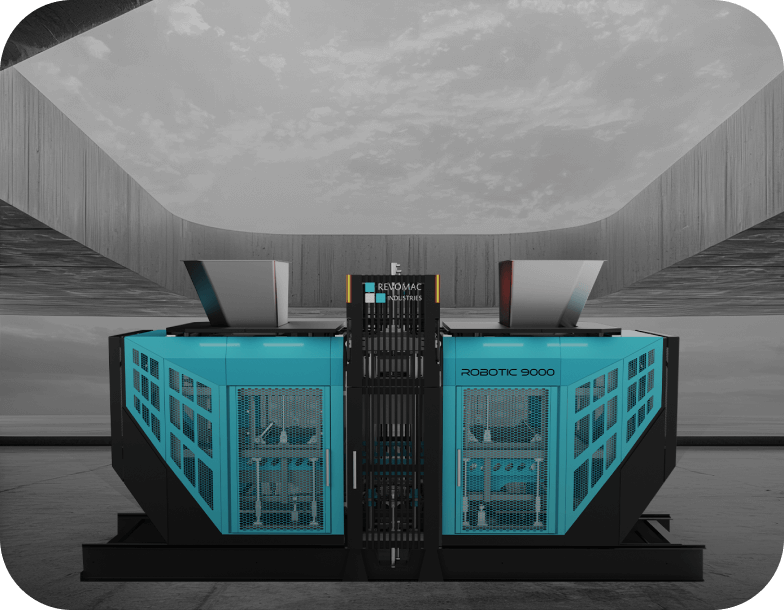
For our fully automatic Jaguar 9000, the stated output range is 4,000 to 30,000 solid blocks per shift, depending on size and configuration.
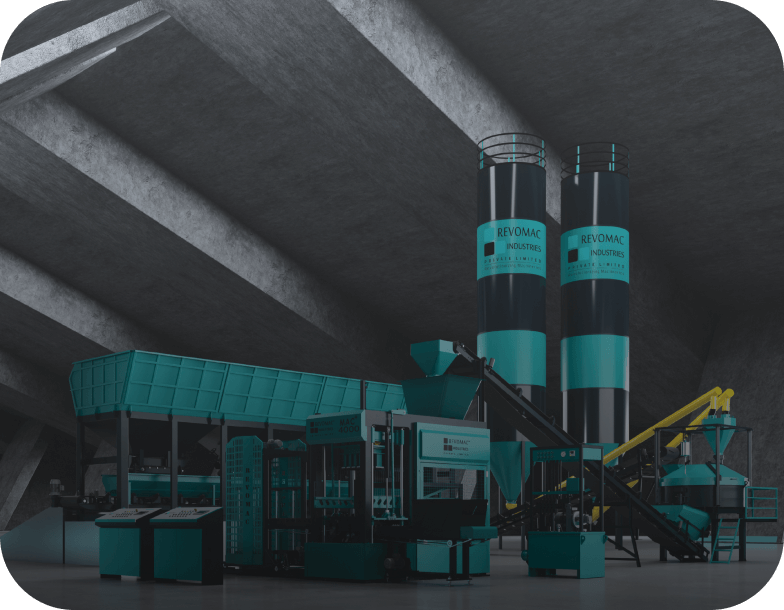
The block machine is only one station. Your plant output is set by its slowest part.
Two machines both called “fully automatic solid block machine” can differ widely in price. These are the main reasons.
| Price factor | Lower cost option | Higher cost option | What it changes for you |
|---|---|---|---|
| Automation | Semi-automatic, manual pallet and block handling | Fully automatic with PLC, auto pallet feed and stacking | Labour per block and consistency |
| Mould size and count | Small moulding area, one mould | Large moulding area, extra moulds for other sizes and pavers | Blocks per cycle and product range |
| Vibration | Fixed-speed table vibration | VFD or servo-controlled vibration | Compaction, cement use and height accuracy |
| Hydraulics | Basic power pack | Faster, well-matched hydraulic system | Cycle time and output |
| Batching | Manual volume batching | Weigh batching plant with cement silo | Mix accuracy and cement control |
| Handling | Manual offloading | Cuber, strapping and wrapping | Labour, breakage and dispatch speed |
| Power | Lower connected load | Higher connected load for larger, faster machines | Electrical connection and monthly bill |
| Build quality | Unbranded parts | Branded motors, gearbox, bearings and switchgear; factor of safety above 1.5 | Breakdowns and machine life |
We design our machines with a factor of safety above 1.5 and use branded motors, gearboxes, bearings and switchgear. In our experience, VFD or servo-controlled vibration lets you reach the same strength with less cement. On a plant making lakhs of blocks a month, that saving matters.
Our machines listed on IndiaMART range roughly from ₹45 lakh to ₹85 lakh depending on model and configuration. These figures are indicative only. Your price depends on the moulds, batching, handling and other options you choose.
Also budget for GST, freight, foundations, installation, pallets and a stock of raw material. Ask every seller what is included in the quoted price.
For a full checklist on comparing machines, see our guide on how to choose a high-quality block making machine.
Most Indian plants make 400 × 200 mm blocks in 100, 150 and 200 mm widths. IS 2185 also allows 500 and 600 mm lengths and other widths, using a different mould.
Multiply blocks per cycle by cycles per hour (3,600 ÷ cycle time in seconds). Then allow about 15% for real-world stoppages.
Under IS 2185 (Part 1), solid load-bearing blocks start at 4.0 N/mm² at 28 days. Your buyers or project may ask for higher.
Our listed machines range roughly from ₹45 lakh to ₹85 lakh by model. This is indicative; contact us for a current quote for your configuration.
Yes, with the right moulds. Pavers need tighter height control, so check this before you buy.
It is not required, but weigh batching keeps the mix the same every cycle. That helps you control cement use and block strength.
Tell us your block sizes, target output per shift and site details. We will suggest the right machine, moulds and plant layout. Contact Revomac →